
Are we alone? Do aliens exist? These are some questions which keep bugging us all the time. In the late 1900s, technology was developed enough to give scientists a sense of confidence about extraterrestrial life.
How strange would it be if there were aliens? “We are alone” and “There’s somebody out there” are two possibilities, each equally scary. To address this major dilemma, scientists initiated a project called SETI—the Search for Extraterrestrial Intelligence—in 1997. The purpose of this mission is to send and receive radio signals from intelligent life in deep space. Beyond SETI, numerous other radio telescopes have been searching for similar signals.
In 1959, Cornell physicists Philip Morrison and Giuseppe Cocconi speculated that any extraterrestrial civilization attempting to communicate via radio signals might use a frequency of 1420 megahertz. This frequency is naturally emitted by hydrogen, the most common element in the universe, and therefore likely familiar to all technologically advanced civilizations. In 1973, after completing an extensive survey of extragalactic radio sources, Ohio State University assigned the now-defunct Big Ear telescope to SETI.
On August 15, 1977 The Ohio State University’s Big Ear Telescope received a weird signal which couldn’t have been created naturally. The signal appeared to come from the constellation Sagittarius and bore the expected hallmarks of extraterrestrial origin. Astronomer Jerry R. Ehman discovered the anomaly a few days later while reviewing the recorded data. He was so impressed by the result that he circled the reading on the computer printout and wrote the comment Wow! on its side, leading to the event’s widely used name.
The Signal
The entire signal sequence lasted for the full 72-second window during which Big Ear was able to observe it, but has not been detected since, despite several subsequent attempts.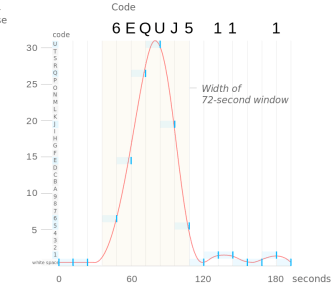
This represents the intensity variation of the radio signal over time, measured as unitless signal-to-noise ratio. A common misconception is that the Wow! signal constitutes some sort of message. In fact, what was received appears to be an unmodulated, continuous wave signal with no encoded information; essentially a flash of radio energy.
Two different values for the signal’s frequency have been given: 1420.36 MHz (J. D. Kraus) and 1420.46 MHz (J. R. Ehman), both very close to the value of 1420.41 MHz of the hydrogen line.
Hypothesis
- Interstellar scintillation of a weaker continuous signal : This basically means that the signal might not be real but an illusion like the twinkling of stars.
- Reflected signal : An earth sourced signal could have been reflected by some debris in space.
- Hydrogeb could surrounding two comets : Antonio Paris proposed that the hydrogen cloud surrounding two comets, 266P/Christensen and 335P/Gibbs, now known to have been in roughly the right position, could have been the source of the Wow! signal.
Well, the signal couldn’t be replicated again and there is no definite information about its source. Could they be aliens? Nobody knows!
These efforts are driven by the profound curiosity and desire to answer one of humanity’s oldest questions: Are we alone in the universe? The discovery of extraterrestrial intelligence would revolutionize our understanding of our place in the cosmos, while the confirmation of our solitude would deepen the mystery of life’s origins on Earth. Regardless of the outcome, the quest to find intelligent life beyond our planet continues to inspire scientific innovation and exploration.
 random curious mind !