In the beginning, there was eternal darkness. And then, bang! An explosion brought forth an endlessly expanding existence of time, space, and matter. Every day, we discover something new, further than ever imagined, beyond the limits of our existence.
Our universe is a magically unbound expanse of space and time brimming with endless possibilities. Imagine a theoretical tunnel providing shortcuts through space and time, or a three-dimensional hole pulling in all light. Picture blue balls of fire undergoing nuclear fusion, becoming heavier, expanding into red giants, and finally exploding due to a collapse under their own weight.
But before venturing into outer space, we must understand science. “Science is a body of knowledge and a method of how we learned that knowledge.” Science teaches us that our assumptions might be incorrect. We need to observe the universe, scrutinize every phenomenon, and make educated guesses about what is happening and why, to uncover the answers.
Understanding the universe requires curiosity and systematic study. We must embrace the scientific method, which involves making observations, forming hypotheses, and conducting experiments to test our theories. This approach allows us to peel back the layers of the unknown, gradually revealing the intricate workings of the cosmos. Through science, we can comprehend the forces that shape the stars, the planets, and the very fabric of reality itself.
In essence, science is our guiding light in the vast darkness of the unknown, enabling us to explore and understand the universe’s profound mysteries. Through diligent study and relentless curiosity, we can unlock the secrets of existence, continually pushing the boundaries of what we know and expanding our understanding of the cosmos.
I know that I am standing on a surface that appears flat but is, in fact, round. This sphere, our Earth, has a metallic core and is enveloped by a fuzzy atmosphere. It is surrounded by a magnetic field that protects us from the constant barrage of subatomic particles from the sun, which is 150 million kilometers away and the strongest source of light, reaching our planet in just eight minutes. This light also illuminates the days of other planets, comets, and asteroids in the main asteroid belt and the Kuiper Belt, which can be considered the outer boundary of our solar system, extending through the Oort Cloud into interstellar space filled with gas clouds and dust lanes. We locate ourselves on one of the outer arms of the Milky Way Galaxy, which has a supermassive black hole at its center. There are millions of such galaxies drifting away from each other due to the expansion of our universe, a phenomenon explained by dark matter and dark energy.
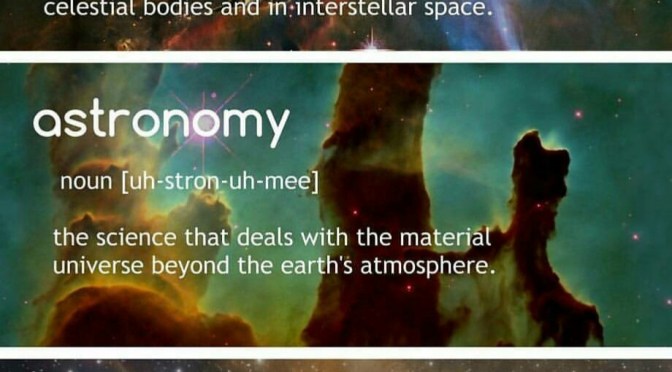
This is what we have learned after decades of intensive research in the field of astronomy. However, it is not just astronomy alone that has provided this information. Astronomy is the study of celestial bodies, their positions, and phenomena such as eclipses and the phases of the moon. It is like an advanced version of stargazing. Observing planets is part of astronomy. But, if we send rovers to a planet, is that still astronomy? We have sent Curiosity to Mars, Juno to Jupiter, and Cassini to Saturn. Curiosity is conducting geology, metallurgy, chemistry, image processing, and almost everything except traditional astronomy. Thus, according to the modern definition, astronomy encompasses everything observed and experimented on beyond Earth’s atmosphere.
Now, you might ask why it is so important to study this field of science. Astronomy has led to revolutions in almost every field. Let’s go back in time, even before telescopes were invented. What did people see then? They clearly knew they lived in a place that seemed stationary while the sky appeared to move. They saw the sun rising and setting, so geocentrism seemed perfectly correct at that time. However, over time, people learned that the sun is the center of the solar system.
The invention of the telescope marked a significant milestone. Galileo and Newton made significant improvements to it. Newton also developed calculus and Newtonian mechanics to understand the behavior of moving planets. As a result, our knowledge of mathematics, physics, and chemistry improved. Then came another revolution: photography. We could capture much fainter objects on photographic plates. Today, we use computers to analyze images taken by telescopes. Over time, astronomy has opened doors to many more branches of study, which aren’t strictly astronomy but are closely connected.
Many people are unaware that Astronomy, Astrophysics, and Cosmology are three distinct but closely related branches of science. Astronomy is the study of celestial bodies, their positions, and their motions in space. Astrophysics, on the other hand, applies principles and laws of physics, chemistry, and mathematics to understand the nature and behavior of these bodies. For instance, Astronomy tells us about the existence of a star system called Trappist-1, approximately 40 light-years away. Astrophysics, however, informs us that the planets in this system have solid surfaces and may be tidally locked to their star, meaning the same side of the planet always faces the star, resulting in perpetual day on one side and perpetual night on the other. This could lead to weather patterns vastly different from those on Earth, such as strong winds blowing from the day side to the night side and extreme temperature changes.
Cosmology is the study of the universe as a whole. It encompasses topics like the Big Bang, dark energy, and the cosmic microwave background. Cosmology relies more on logic and reasoning than on direct observation and analysis. It seeks to understand the large-scale properties of the universe and its origins, structure, evolution, and ultimate fate.
About a century ago astrology was also a science. Astrologists looked into the night sky to predict the positions of planets and expressed how they affected our lives. What we do not realize is that the night sky is changing. The position of our earth in the milky way is not where it was a hundred years ago. The constellations are changing. Thus in today’s date astrology is more like a pseudo science.
It’s not just scientists who enjoy the pleasure of studying astronomy; everyone can become an amateur astronomer with some basic knowledge. We are all born scientists, and curiosity is a fundamental part of being human. Astronomy encompasses several categories: simulation/computation, observation, theoretical physics, and experimental physics. Theoretical physics involves applying laws and equations to prove new theories and is notoriously challenging. Experimental physics often requires large and expensive apparatus. However, observation is something everyone can engage in!
Take William Herschel, for example. A classically trained musician, he became an amateur astronomer who discovered Uranus and was the first to observe binary star systems. With a good amateur telescope, you can observe changes in the sky and report your findings to an astronomical society. Significant discoveries can earn you recognition. Thomas Bopp and Carolyn Shoemaker are notable amateurs who made significant contributions, discovering 32 comets, 377 minor planets, and 800 asteroids!
For those without a telescope, many citizen science organizations allow you to analyze their data using your computer. NASA frequently offers opportunities for public participation. For instance, the JunoCam project invites everyone to analyze and process images taken by the Juno probe.
Astronomy is an accessible and exciting field for anyone with a curious mind. Whether through direct observation with a telescope or participating in citizen science projects, everyone has the potential to contribute to our understanding of the universe.


 random curious mind !