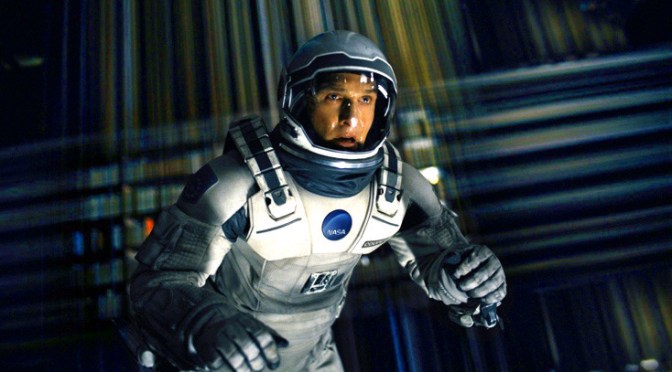
WARNING: Major Interstellar Spoilers Ahead
Due to the excessive pollution in cities, it’s tough to spot stars. When I was in school, even the few sparkling dots in the sky were enough to make me forget all my worries. I could spot the Orion constellation and Sirius from my balcony. Venus and the ISS flyby used to be the icing on the cake. As famously stated by Plato, “astronomy compels the soul to look upwards and leads us from this world to another.” I used to enjoy the night sky often, but for some unknown reason, I stopped—until I watched Interstellar.
I had watched multiple YouTube videos, read tons of articles, and knew about 4-dimensional geometry, yet I was left dumbfounded when I watched Interstellar. Unfortunately, I had already encountered spoilers. I knew that higher dimensions were involved, but Christopher Nolan managed to astound me with the tesseract. Interstellar took the filmmaker’s usual Rubik’s cube narrative structure and blended in a hearty dose of astrophysics, completely baffling the audience. Cooper gets NASA’s coordinates from ‘them,’ and that’s where his journey begins. Before Cooper departs for his mission, Murph tells him that she has decoded a Morse code message communicated via her bookshelf, which reads: “STAY.” In the end, we’re brought back to the same room, the same time, the same message but in a higher dimension. Cooper gave himself the coordinates. Cooper brought himself there. If Cooper hadn’t given the coordinates, how would he have gotten there? And remember the handshake at the end? Cooper was the ghost; Cooper was ‘them’. All of this is so confusing, isn’t it? It’s a paradox!
A paradox is “a seemingly absurd or contradictory statement or proposition which, when investigated, may prove to be well-founded or true.” The infinite hotel is a paradox. A boy traveling to the past to kill his grandfather is a paradox. A twin coming back home to meet his sibling after a flyby around a black hole, only to find himself younger than his twin, is a paradox.
Let’s travel 13.8 billion years backward to the moment of the Big Bang, when time and space sprang into existence out of literally nothing. Or consider light—is it a particle or a wave? Why can’t we determine the position and momentum of an electron simultaneously? Are these paradoxes as well? No, they aren’t.
The evolution of the universe is a theory, whereas the principle stating that we cannot simultaneously determine the momentum and position of an electron is the Heisenberg Uncertainty Principle. A hypothesis or a theory is either a suggested explanation for an observable phenomenon or a reasoned prediction of a possible causal correlation among multiple phenomena. The major difference between a scientific law and a scientific theory is that theories are huge, complex structures with ragged edges that would take a book to describe, whereas a law or a principle has been experimentally verified and can be written in a single sentence.
So this is what we’ll be discussing in the following posts: String Theory, the Big Bang Theory, Newton’s (rejected) Corpuscular Theory, the Duality Principle, Gravity, and much more. A quick suggestion—if you haven’t watched Interstellar, go and watch the movie right now!
Keep looking up!
 random curious mind !